
Why Creativity Is Just as Important as Math and Reading
- Ananya Suksiluang
- Sep 24, 2025
- 4 min read


The Hidden Power of Creativity in Education
Most parents picture school success in numbers and letters: strong math scores, fluent reading, neat handwriting. But there’s another skill hiding in plain sight—creativity. Too often seen as a “bonus” subject, creativity is actually a life skill, one that stands shoulder to shoulder with math and reading. In fact, it may be the very foundation that helps children thrive not just in school, but in life beyond the classroom.
Why Schools Overemphasize Math and Reading
Traditional schools put enormous emphasis on math and reading. The reason is simple: these are easy to test, easy to grade, and easy to compare across children. Governments and institutions rely on standardized scores to measure progress, so naturally, classrooms follow suit. But what gets lost in this equation is the wider definition of intelligence. A child who can solve an algebra problem might not be as valued as one who writes a story or designs a solution to a real-world challenge. And yet, it is those creative problem-solvers who often go on to make the biggest impact.
Creativity as a Core Life Skill
Creativity is not just painting or singing—it’s a way of thinking. It’s the ability to imagine new possibilities, to solve problems when the answers aren’t in the back of the textbook, and to approach challenges with flexibility. Adults use creativity every day without even realizing it: finding a new way to budget, inventing a recipe with what’s left in the fridge, or brainstorming how to keep kids entertained during a power outage. In a fast-changing world, creativity isn’t a nice-to-have—it’s survival.
How Creativity Strengthens Academic Skills
Research consistently shows that creativity and academics don’t compete—they reinforce each other. For example, Rauscher and Shaw’s (1997) study on the “Mozart Effect” found that exposure to music can enhance spatial-temporal reasoning, which supports mathematical skills. A 2013 University of London study (Winner et al.) demonstrated that drama and storytelling improve literacy by enhancing comprehension and empathy. Project-based learning research by Thomas (2000) revealed that when students connect abstract concepts to real experiences, their depth of understanding increases significantly. In other words, when students engage their imagination, their math and reading skills grow stronger, not weaker.
Creativity in Action at KSI Academy
At KSI Academy, creativity is not treated as a side subject—it’s at the heart of learning. In art, students express personal ideas instead of copying from a book. In music, they collaborate, discovering rhythm and sound while learning teamwork. In projects, like Flow Days and Culture Lab, children design, test, and present ideas that cross traditional subject boundaries. One group might explore how Thai festivals compare to global ones, while another designs digital artwork that tells a story. Each project integrates creativity with core academics, showing that learning doesn’t have to be split into boxes.
Creativity Builds Confidence and Agency
One of the biggest myths is that creativity is only for the “artsy” kids. In reality, it builds confidence for every child. When a student creates something new—whether it’s a story, a song, or a science experiment—they learn that their ideas matter. They practice taking risks, facing setbacks, and trying again. This aligns with research by Beghetto & Kaufman (2014), who found that everyday creativity develops resilience and self-efficacy. This sense of agency is exactly what parents want: children who believe they can shape their own futures.
Why Creativity Should Not Be Seen as Extra
Parents often think of creativity as an “extra” subject, like a treat after the serious work is done. But this thinking misses the point. Creativity is not an add-on; it’s the foundation. The future workforce won’t reward those who can memorize facts (AI already does that faster). It will reward those who can think differently, connect ideas, and adapt to new challenges. The World Economic Forum’s 2020 Future of Jobs Report listed creativity, originality, and initiative among the top five skills needed for the workforce of 2025. These are the qualities that creative learning develops naturally.

How Parents Can Nurture Creativity at Home
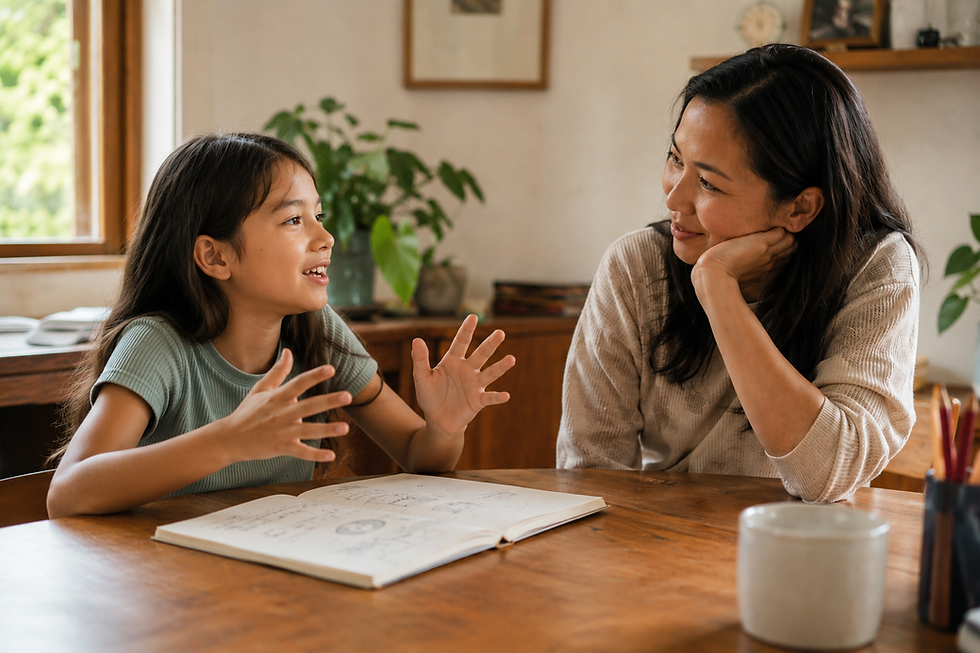
Parents play a huge role in keeping creativity alive. The good news is, it doesn’t require expensive tools or advanced training. Give your child open-ended playtime with blocks or paper and markers. Encourage them to tell stories instead of always sticking to the book. Let them experiment in the kitchen, or try solving a problem their own way before stepping in. Balance is key: worksheets build skills, but sketchbooks and storytelling build imagination. Together, they create a well-rounded learner. A study by Torrance (1981) showed that children encouraged to engage in divergent thinking at home display higher levels of problem-solving and adaptability later in life.
Creativity + Academics = Whole Child Learning
When parents look for the right school, they should ask not only about test scores but also about opportunities for creativity. Because the truth is clear: creativity doesn’t compete with math and reading—it completes them. At KSI Academy, we believe education is an organic process, not a mechanical one. Just like a garden, children need space to grow in all directions. By nurturing creativity alongside academics, we help students grow into confident, curious, and capable young people. If you’d like to see how this looks in practice, we invite you to visit KSI Academy and experience it for yourself.


Comments