
When Curious Kids Stop Asking Questions: How Parents Can Help Children Reconnect With Curiosity After Burnout
- Ananya Suksiluang
- Mar 11
- 4 min read

What Happens When a Curious Child Suddenly Stops Asking Questions
One of the earliest signs of learning burnout in children is surprisingly quiet: the questions stop.

Young children are naturally curious. They constantly ask why things happen, how machines work, or what might happen if they try something new. Curiosity is the engine that drives learning. Research in developmental psychology shows that curiosity activates the brain’s reward system and improves memory formation.
When curiosity disappears, it rarely means a child has stopped caring about the world. More often, the child has simply run out of emotional energy to stay engaged.
Instead of asking questions, the child may begin doing the minimum required. They rush through work, avoid challenges, or say they are bored with learning. Many parents interpret this as laziness, but in many cases it is actually a sign of burnout.
Learning begins to feel less like discovery and more like performance.
What Curiosity Burnout Looks Like in Children
Curiosity burnout in children does not always appear dramatic. It often shows up through small behavioral shifts that gradually become more noticeable.
Children experiencing learning burnout may stop asking questions, avoid difficult tasks, or lose interest in subjects they once enjoyed. Some children become unusually quiet in learning situations, while others show frustration or impatience when faced with challenges.
You might also notice children rushing through work just to finish, choosing the safest or easiest option, or expressing that learning feels tiring even when the task is simple.
These behaviors are not signs that a child cannot learn. They are signals that the child’s motivation system has become overloaded.
Why Curiosity Sometimes Shuts Down
Curiosity thrives in environments where exploration feels safe. When children feel constantly evaluated, rushed, or afraid of making mistakes, the brain shifts into protection mode rather than exploration mode.
Several common experiences can gradually suppress curiosity:
Pressure to always perform well.
Fear of being judged for wrong answers.
Highly structured schedules with little time to explore.
Constant correction instead of discussion.
When these pressures accumulate, children may begin to associate learning with stress instead of discovery. The brain naturally avoids activities connected to stress, even if those activities once felt exciting.
The Hidden Cost of Always Performing
Many children today feel that learning is something they must get right rather than something they can explore.
When every assignment, test, or activity feels like an evaluation, curiosity slowly transforms into performance anxiety. Children begin focusing on avoiding mistakes instead of investigating ideas.
Psychologists studying intrinsic motivation have found that heavy emphasis on external rewards and evaluation can reduce a child’s natural desire to explore. Edward Deci and Richard Ryan’s Self-Determination Theory explains that curiosity grows when children experience autonomy, competence, and psychological safety.
Without these conditions, motivation becomes fragile and easily exhausted.
Rebuilding Psychological Safety for Learning
Helping children reconnect with curiosity often begins with reducing the pressure around learning.
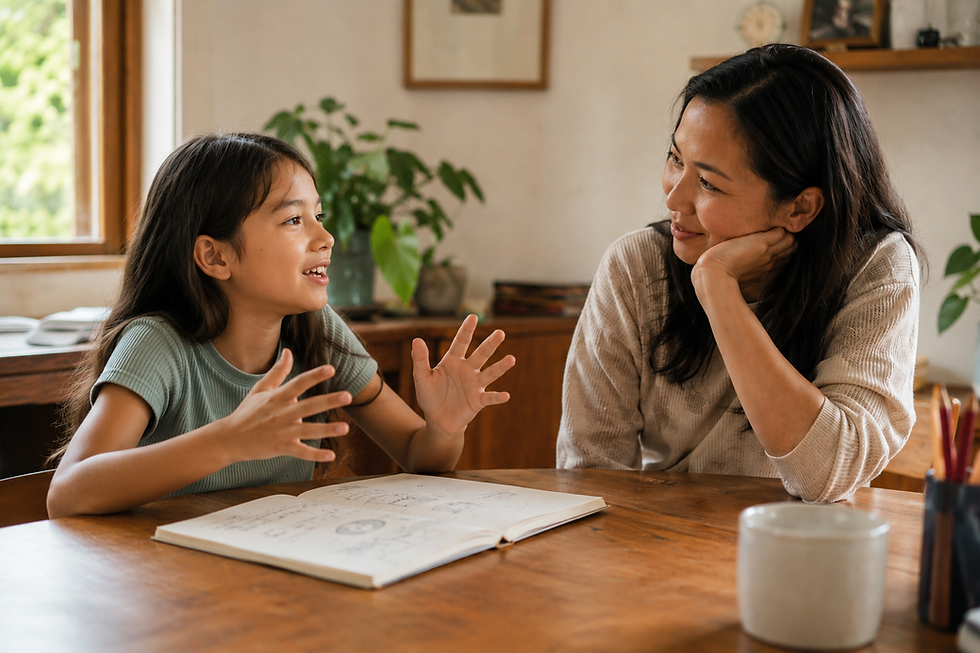
Parents can start by shifting conversations away from results and toward thinking. Instead of asking "Did you get it right?" try asking "What surprised you today?" or "What was the most interesting thing you noticed?"
When children realize they are not being judged for every answer, their brains slowly return to exploration mode.
It is also helpful to normalize mistakes. When adults openly discuss their own learning struggles, children understand that uncertainty and trial-and-error are natural parts of learning.
Curiosity grows in environments where questions are valued more than perfect answers.
Small Daily Habits That Reignite Curiosity
Rebuilding curiosity does not require dramatic changes. Often it begins with small shifts in daily life.
Families can introduce simple curiosity rituals such as wonder questions at dinner, nature walks where children observe patterns, or creative projects where there is no single correct outcome.
Encouraging children to design experiments, build things, or investigate their own questions can gradually rebuild intrinsic motivation.
When children see that learning can still be playful and exploratory, curiosity begins to return naturally.
Giving Children Permission to Be Beginners Again
Burnout often makes children afraid of looking incompetent. They may avoid new challenges simply because they worry about failing.
Parents can help by celebrating the process of learning rather than the final result. Praising effort, persistence, and creative thinking sends a powerful message that struggling is part of growth.
When children feel safe being beginners again, they start taking intellectual risks. Those small risks are exactly where curiosity begins to grow.
What Curiosity Looks Like When It Returns
When curiosity returns, the change is usually obvious.
Children begin asking questions again. They spend longer exploring ideas and show genuine interest in understanding how things work. Instead of rushing through tasks, they start experimenting, revising, and thinking more deeply.
Most importantly, learning begins to feel energizing rather than exhausting.
Curiosity is not something children must be forced to have. It is a natural human drive that emerges when the environment supports exploration, safety, and genuine interest.
For parents, the goal is not to push curiosity back into children. The real goal is to remove the pressure that made curiosity disappear in the first place.
When that pressure lifts, curiosity often comes back on its own.
At KSI Academy, we design learning environments that protect and nurture curiosity. Mixed-age classrooms, project-based learning, and mentoring relationships help students explore ideas deeply while feeling safe to experiment and grow.


Comments