
What Kind of Learner Is Your Child? (And Why It Changes Everything)

Picture this: your child can't sit still during homework. They zone out when you read instructions aloud. Their teacher says they're "not focused." But at home? They spend two uninterrupted hours building an intricate LEGO city, narrating every detail with complete confidence.
So who's right — the teacher, or what you see at home?
The answer might be neither, and both. Because the real question isn't whether your child can focus. It's whether the way they're being asked to learn actually matches the way their brain works best.
Understanding your child's learning style isn't about finding an excuse. It's about finding the key.
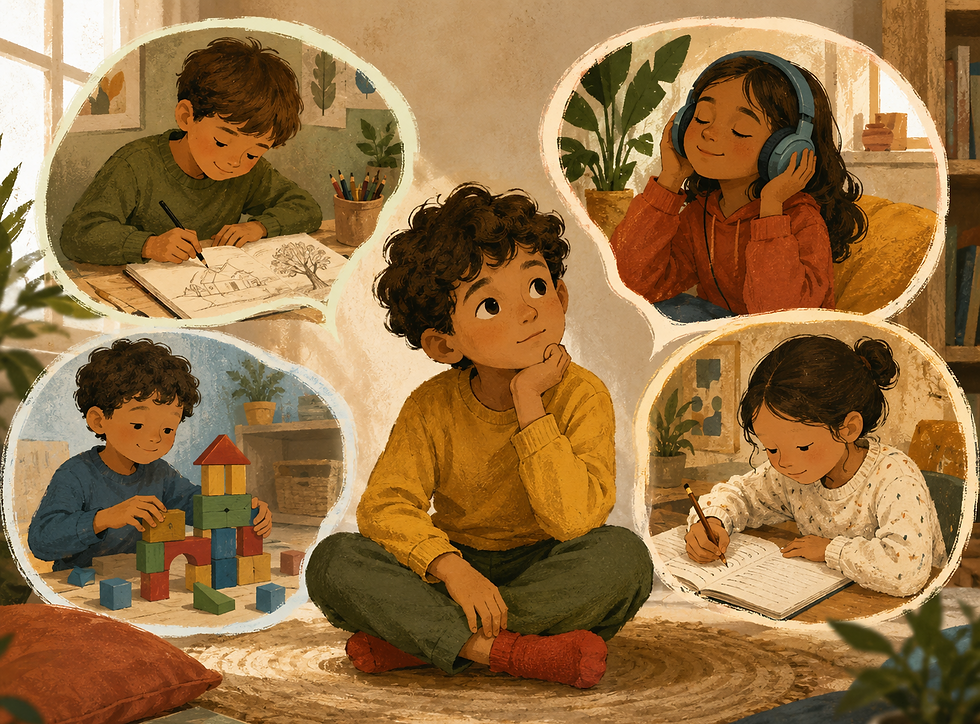
Learning Styles Are Real — But More Nuanced Than You Think
You've probably heard of learning styles before. The most widely used framework is called the VARK model, which identifies four types:
Visual — These learners understand best through images, diagrams, charts, colour-coding, and spatial organisation. They often think in pictures and benefit from seeing information laid out visually rather than just hearing it.
Auditory — These learners absorb information best through listening and speaking. They tend to remember things they've heard, enjoy discussion, and often talk through problems out loud to make sense of them.
Kinesthetic — These learners need to do in order to understand. They learn through movement, hands-on experience, and real-world application. Sitting still and listening passively is genuinely hard for them — not a behaviour problem.
Read/Write — These learners connect best with the written word. They like taking notes, reading instructions, making lists, and expressing their understanding through writing.
There's truth in this — but here's the nuance most people miss: very few children are purely one type. Most are a blend, and that blend can even shift depending on the subject or context. A child might be highly visual when learning about history but deeply kinesthetic when working through maths.
The value of knowing about learning styles isn't to label your child. It's to give you a lens — a way of observing more carefully. When you know your child leans visual, for example, you might notice that they understand their spelling words much better when they write them in big colourful letters rather than repeating them aloud. Small shift, big difference.
Labels are a starting point, not a finish line.
Beyond Learning Style — Temperament Matters Too
Here's something the VARK model doesn't capture: how a child engages with the learning process itself.
Some children need quiet and stillness before they can respond. Ask them a question too quickly, and they'll shut down — not because they don't know the answer, but because they haven't had time to process it yet. Others think out loud. Their ideas only become clear as they speak, and silence actually gets in the way.
Some children are energised by working in a group. The buzz of other people thinking helps them think. Others do their very best work alone, and group settings drain them before the task even begins.
Researchers and educators sometimes call this learning temperament — and it includes patterns like:
Cautious vs. bold: Does your child hang back and observe before trying something new, or do they dive straight in?
Sensitive vs. adaptable: Does your child feel errors deeply and need reassurance, or do they brush off mistakes and move on quickly?
Reflective vs. impulsive: Does your child pause before answering, or respond immediately — sometimes changing their answer halfway through?
None of these are better or worse. But each one shapes how a child experiences school, feedback, group work, and challenge. A cautious child in a classroom that rewards speed will feel chronically behind — even if they're deeply capable.
Simple Signs to Watch for at Home
You don't need a test or a specialist to begin understanding your child's learning profile. You just need to watch them — not while they're doing homework, but while they're doing something they love.
Here are some questions to sit with:
How does your child explain something they're excited about? Do they grab paper and draw it out? Do they act it out with their body? Do they talk at length, in great detail? Do they write it down or look for a book about it? The way a child naturally explains something they care about is often the purest window into how they process information.
How do they react to a new challenge? Do they want to read the instructions first, or do they start doing and figure it out as they go? Do they ask lots of questions, or do they prefer to observe quietly before trying?
What does play look like? Play is learning in its most natural form. A child who builds elaborate structures is showing spatial, kinesthetic thinking. A child who invents detailed storylines and characters is showing narrative, language-based thinking. A child who sorts, organises, and categorises is showing analytical, pattern-based thinking.
You're not diagnosing anything. You're simply paying attention — and that attention is one of the most powerful things a parent can offer.
Why This Matters
When you understand how your child learns, two things shift.
First, you become a better advocate. School systems — even well-meaning ones — are often built around one or two dominant learning styles. If your child happens to fit that mould, they'll likely do fine. If they don't, they can spend years feeling like something is wrong with them rather than with the fit. Knowing your child's style means you can ask better questions, request different accommodations, and have more informed conversations with teachers.
Second, life at home gets easier. So many homework battles, after-school meltdowns, and moments of resistance aren't about stubbornness or laziness. They're about exhaustion — a child who has spent all day trying to learn in a way that doesn't come naturally to them. When you understand this, you stop fighting the child and start addressing the real friction. Maybe it's a movement break before homework. Maybe it's letting them explain their work to you verbally instead of writing it all down first. Maybe it's simply sitting beside them quietly instead of talking them through it.
Small adjustments, rooted in understanding, can transform the dynamic entirely.
This Week: Observe With Fresh Eyes
Before you do anything else — before you research programmes or book consultations or change routines — just watch your child this week.
Watch them play. Watch them explain. Watch how they respond when something is hard, and how they respond when something clicks. Notice what makes them light up, and what makes them shut down.
You know your child better than any system does. This week, trust that. Let what you see inform how you support them — not the other way around.
Because when a child feels genuinely known — not just managed or assessed — learning stops being something that happens to them. It becomes something they own.


Comments