
The Difference Between a Good Student and a Real Learner

Why performance-based education produces confident test-takers who struggle outside the classroom
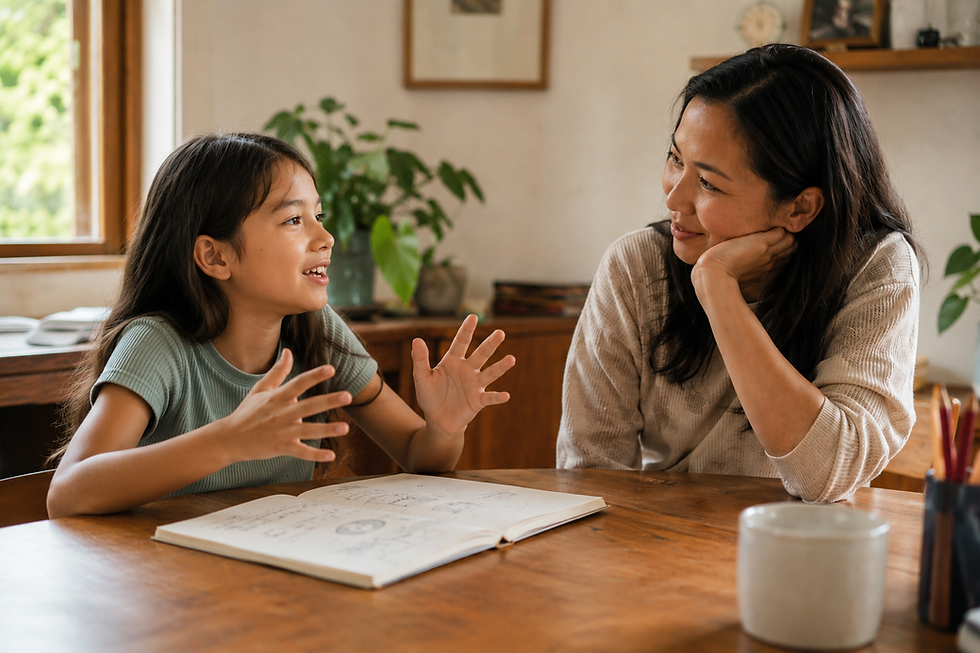
Picture a child who has never brought home anything but top marks. Ask her to explain a concept from a textbook, and she'll recite it word for word. But hand her a real-world version of the same problem — one that doesn't come with the familiar setup or expected format — and she freezes. Not because she lacks intelligence. Because somewhere along the way, she learned to succeed within a system, without necessarily learning to think beyond it.
This gap is more common than most parents realize, and it rarely shows up on a report card. It shows up later — in college, in first jobs, in moments that call for original thinking rather than a memorized answer.
What's the Difference Between Performing and Learning?
At a glance, a "good student" and a "real learner" can look identical. Both do well on tests. Both raise their hands. Both bring home report cards parents are proud of. But underneath, they're often running on very different fuel.
Performing is driven by external validation. The goal is the grade, the praise, the gold star — and the underlying question is usually "What does the teacher want to hear?" Mistakes feel dangerous because they threaten the reward.
Learning is driven by understanding. The goal is being able to actually use an idea — in a new context, a messy situation, or a question nobody has asked before. Mistakes are simply part of the process, not evidence of failure.
Both modes can produce the same grade. Only one produces a thinker who can operate without a script.
Why Good Grades Don't Always Mean Deep Learning
A child optimizing for performance often becomes remarkably good at a narrow skill: figuring out exactly what's expected and delivering it. That's a real skill — but it's not the same as understanding.
The hidden costs tend to surface later, and quietly:
Difficulty with ambiguity. When there's no obvious "correct" answer to locate, performance-oriented kids can feel unmoored rather than curious.
Mistake-aversion instead of mistake-tolerance. Errors feel like exposure, not information — which makes genuine risk-taking, the kind real learning requires, feel unsafe.
Fragile confidence. Self-worth becomes tied to the last score rather than to a track record of figuring things out — a shaky foundation to build on.
None of this means the child is doing anything wrong. It means the environment has, understandably, taught them what gets rewarded — and they've adapted accordingly.
How Kids Learn to Please Instead of Think
This pattern rarely comes from one dramatic cause. It tends to build gradually, from a few ordinary, well-intentioned sources:
Standardized testing culture. When a single number defines success, it's natural for kids to aim at the number rather than the understanding behind it.
The language of praise. "You're so smart!" feels supportive, but it links identity to outcome. "You really stuck with that one — I could see you trying different approaches" links identity to process, which is far more durable and motivating over time.
Modeled fear of failure. Kids are perceptive. If mistakes are met at home with disappointment or over-correction, they quietly absorb the lesson that getting it right matters more than understanding why.
The good news: because this pattern is learned, it can also be gently unlearned — and parents are in an unusually powerful position to do it.
Simple Ways to Encourage Real Learning at Home
Small, consistent shifts in language and attention tend to matter more than any single big conversation.
Praise the process, not just the outcome. Instead of "You got an A!" try "What part of this took the most thinking?"
Normalize "I don't know yet." This phrase should feel like a respectable answer — not a failure to fix immediately.
Ask questions that reward thinking, not just correctness. "What made you choose that approach?" invites reflection in a way "Is that right?" never can.
React to mistakes with curiosity. A simple "Interesting — what do you think happened there?" teaches a child that errors are data, not verdicts.
These aren't major interventions. They're small, repeatable moments — and repetition is exactly what reshapes a pattern over time.
An Invitation, Not a Verdict
If parts of this description feel familiar, that's not cause for alarm — and it's certainly not a verdict on your child, or on your parenting. Most children move between performing and learning depending on the subject, the day, or the environment they're in. The goal isn't to diagnose a flaw. It's to notice the pattern with curiosity — the same curiosity we hope to build in our kids.
Learning, at its core, isn't a report card. It's a habit of mind, built moment by moment, question by question, mistake by mistake. And it's a habit that can be nurtured at any age, starting with nothing more than the questions we choose to ask at the dinner table tonight.


Comments